
Gallery

After All
Many millennia after forests learned how, humans are discovering that trees have complex vascular, mycorrhizal, fungal, electrical, and pheromonal ways of networking and relying on one another for species survival. They are communal, familial, and have symbiotic relationships with a diverse range of organisms in the forest floor and with one another. Trees share nutrients, light, threat signals, adaptive responses, and become stronger through community than when thinned or separated. Undamaged forests live in interconnected cooperation, not in competition as once we thought. They’ve evolved to share resources, to continuously adapt and nurture.
Humans have learned very little from forests and have learned it so late. In our nature, however, as often embodied by the youngest of our species, are impulses of empathy, connection, resiliency, and hope. The symbiosis urgently required to sustain our habitat and one another may rely on these innate potentials of humans, forests, and an awareness of our entanglement with all species.
Handmade artist books available in limited editions. Large format negatives developed in caffenol or x-tol. Prints and books are hand-coated on cotton papers, using low-waste methods of palladium printing.

Via
While walking, we see and are seen, we engage ourselves with our neighborhoods, pause to notice bits of the world we may otherwise not, and we experience the world at the human pace. These images were made amidst the communities and social rituals of others in an attempt to embrace a slower pace and a more communal spirit. As a Midwestern American, I too often travel by car, missing so much as I go. These images are made during rare and distant opportunities to immerse myself in the minutia of my surroundings, to see and be seen, and to navigate the world at a more appreciative pace. I photograph in Italian and Spanish historic town centers where walking is the primary mode of transportation and daily visual experience and expression are everywhere emphasized. Through the context and tradition of strolling through historic streets, I observe my global contemporaries and record visual fragments of our combined cultures.
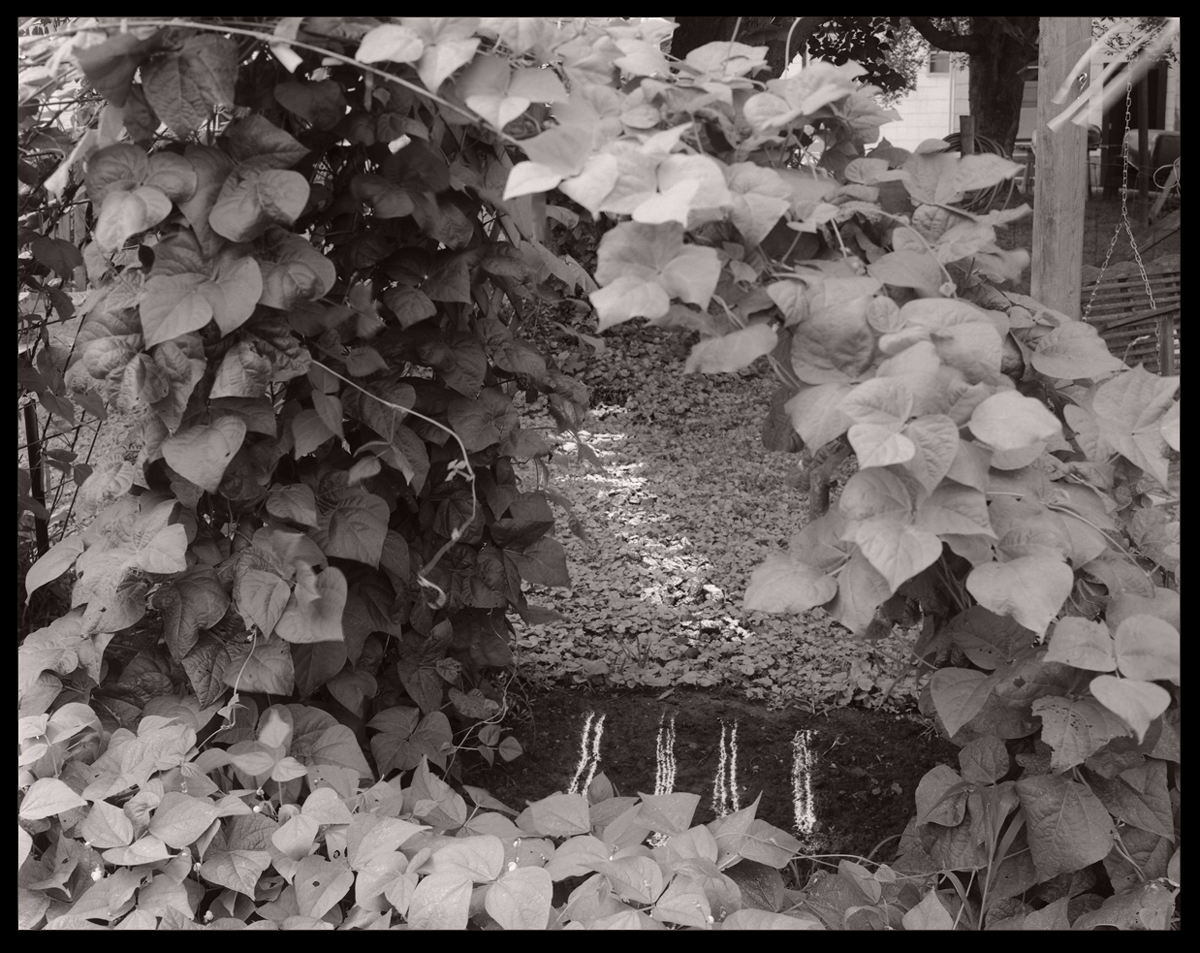
Near
My search for poetic associations between place and experience is facilitated through my fascination with the photographic object. A photograph as image, memento, and referent to absence is physically touched by the past yet allows for a new experience through the photographic object. Photographs as tangible evidence/residue from events, experiences, relationships, and places offer me the ability to associate the specifics of the past with image/objects. That layering of characteristics inherent in the photographic object provides the basis of my approach to image-making. By using the specifics that photographs can render, I attempt to connect places and ideas through visual associations.
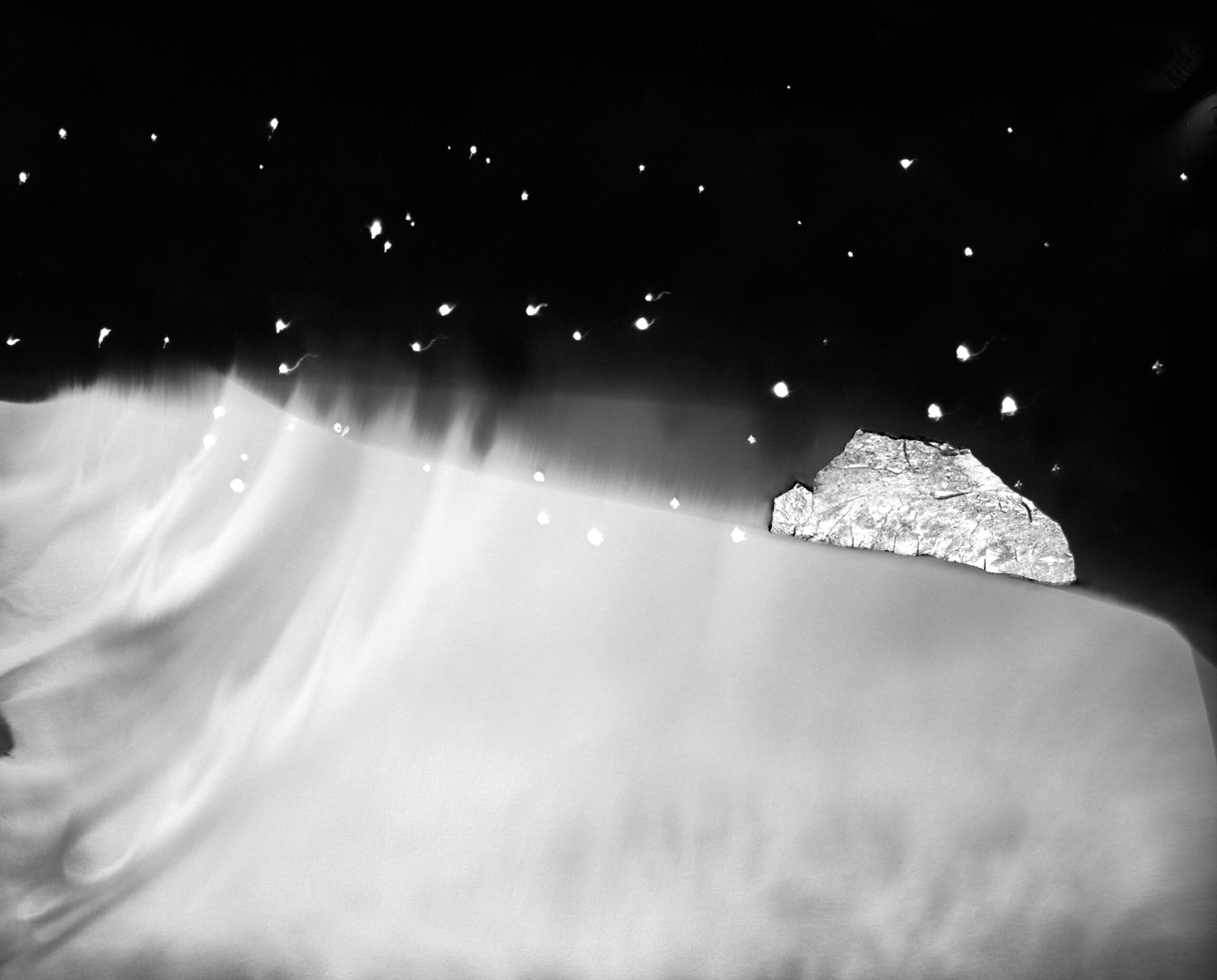
Farthest North
My fictional and fragmented images, made from camera-less chemigrams and collaged snippets from my own photographs, attempt to slice through history, space, galaxies, and reconfigure our understanding of our position in the world as both precarious and hopeful. This ancient rock on which we reside offers a context for reveling in uncertainty and peering into the vastness of incomprehensible things. I am a skeptic but I search for the sacred, somehow attached to the ancient and adjacent to the wisdom of the natural world. The rocks, skies, caverns, and stars offer limitless possibility for wandering among the unknown and clasping the occasional slippery fragment of sacred, ancient knowledge. How will we retain fragile hope in a world spinning an orbit of waste and confusion? How do we navigate the unknown with respect and care instead of destruction? These images explore the precarity and insignificance of our existence while promoting the spirit of our imaginations and insistent hope.
“It is such a mysterious place, the land of tears.”
― Antoine de Saint-Exupéry, The Little Prince